

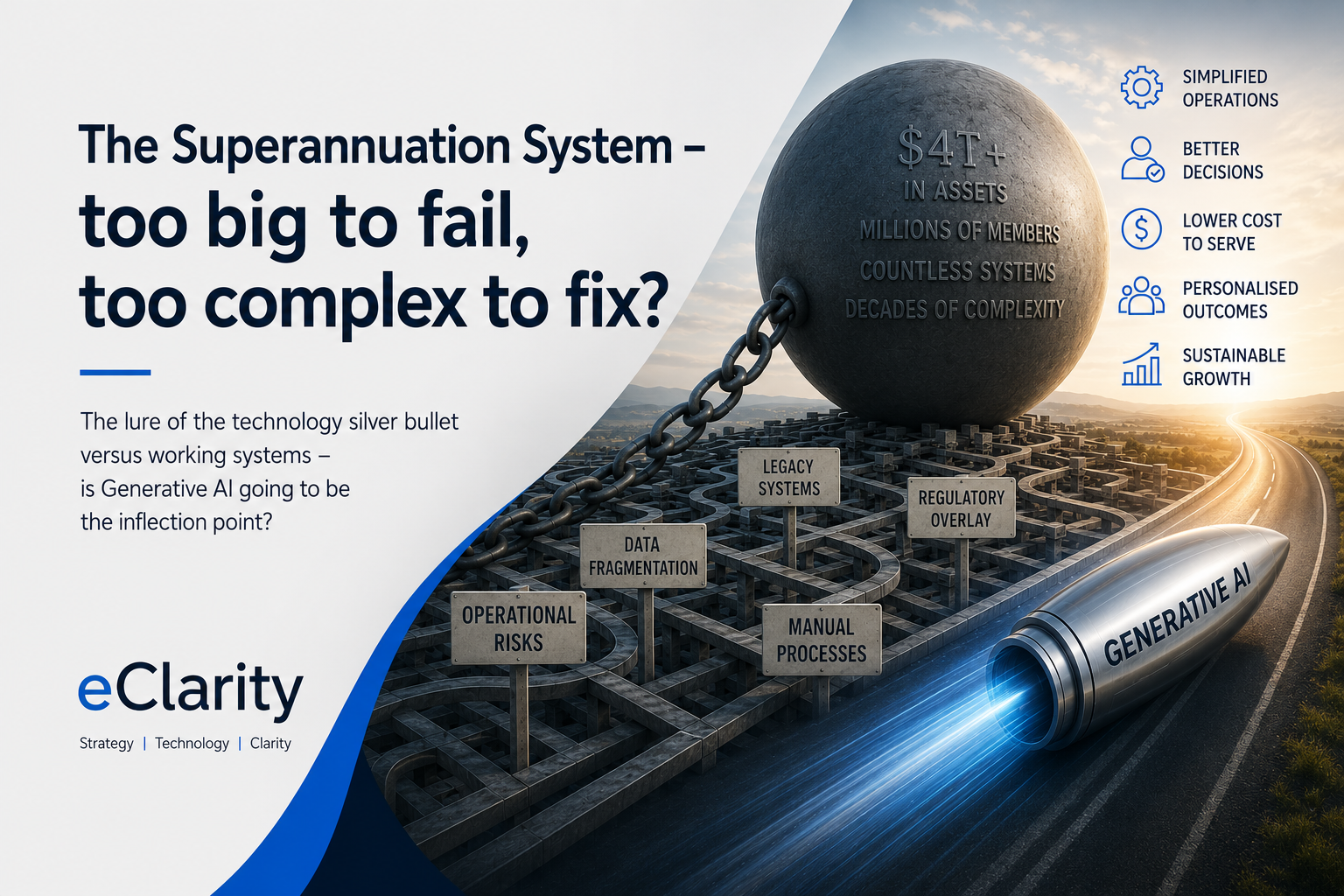
The lure of the technology silver bullet versus working systems, is AI going to be the inflection point?
(10 minute read – if you are a slow reader)
Introduction
The Australian wealth and superannuation industry is not broken.
At its core, it remains one of the strongest and most resilient retirement systems globally. Funds continue to grow, members continue to accumulate wealth, and despite market volatility, regulatory change and significant operational pressure, the system continues to function.
But stability should not be confused with efficiency and future proofing.
Over the last two decades plus, the industry has accumulated extraordinary levels of complexity. Technology environments have become fragmented, operating models layered, governance frameworks expanded and transformation programs continuous. Most of these changes were implemented for entirely rational reasons:
- regulatory reform and risk and compliance
- mergers and consolidation
- product expansion and retirement solutions
- digital engagement and technology/cyber security
- operational scale and efficiency to reduce costs to members
The problem is not how complexity emerged. The problem is that very little of it has been removed. The result is an industry that generally works — but works far harder than it should.
The industry’s hidden problem
Most of the inefficiency in wealth and superannuation is invisible to members.
It does not present as outright failure. It presents as operational friction, slow transformation, high cost-to-serve, duplicated processes, manual intervention sitting underneath automation narratives and systems that rely heavily on people understanding how to navigate the gaps
Over time, effort has replaced design. Organisations have become increasingly dependent on:
- reconciliation of disparate data instead of trusted data
- operational knowledge instead of structural simplicity
- governance layers instead of reducing dependency
- Outsourcing the “problem” areas
Transformation in this industry often feels endless.
While there have been some new platforms introduced as well as workflow layers added, data environments modernised, digital engagement focused on many organisations remain operationally heavy, risky and highly vulnerable. That is because complexity is often redistributed rather than removed.
Why the industry absorbs inefficiency
In most industries, inefficiency of this scale would eventually force structural change. Margins would compress. Capital would move. Competitors would expose weakness. Superannuation funds and wealth managers behave differently because of their scale, barriers to entry and guaranteed flows of new money.
When operating across trillions of dollars in assets, large transformation overruns or inefficient operating models become survivable. Costs are spread across areas like administration reserves, operational budgets, CAPEX projects and often funded by members money in what becomes a rounding error in fund performance. It is still many millions of dollars it just goes mainly unseen. For Trustees this creates an uncomfortable dynamic.
The system is large enough to absorb many of its mistakes without being forced to fundamentally confront them. Many projects that under-deliver are often re-scoped, stabilised, extended or forgotten and costs absorbed into broader operating models. Rarely do we see accountability placed on trustees, executives or consulting firms for these less than successful projects.
One exception was the forced SuperStream environment that required government and regulator intervention to drag the Superannuation market into the 21st century. Implementing SuperStream initially cost the Australian superannuation industry roughly $1 billion to $1.2 billion. This massive price tag included a budgeted $467 million levied to fund the Australian Taxation Office’s (ATO) capability build, alongside hundreds of millions in private capital expenditures for super funds and employers to overhaul their IT and administrative systems.
Prior to the reforms, processing over 100 million transactions a year cost the industry roughly $3.5 billion annually. The introduction of standardized, “straight-through” electronic processing drastically drove down per-transaction costs with EY and the FSC originally estimating that SuperStream would deliver annual system savings of up to $1+ billion, with significant ongoing savings and members servicing benefits.
Sadly, without this mandating of change the industry only slowly moves forward and rarely simplifies itself in a meaningful structural way.
The transformation mirage
The industry has now spent many decades in continuous transformation.
Platform replacement programs, cloud migration, digital servicing, low-code workflow environments and operational modernisation have become standard strategic initiatives across the market. Then there is the insource, outsource and hybrid operating BPO/BPaaS models that cycle every decade or so.
Many of these programs deliver genuine improvement, but very few materially reduce structural dependency across the operating model itself.
This is where transformation becomes problematic. Most programs focus on areas such as replacing individual components, improving interfaces for customers, modernising workflows in complex non-connected ways and digitising existing processes passing the administration to their customers.
Far fewer address the more difficult challenge, simplifying how the organisation fundamentally operates and making it easy, more secure and better for customers.
This distinction matters – transformation without simplification eventually creates more complex integration points, more operational dependency, more governance overhead and more complexity to manage. The system evolves but does not necessarily become lighter.
Real-world lessons, but do we learn?
The industry has repeatedly seen ambitious transformation programs struggle under the weight of operational reality. From the Authors memory these have been occurring since the 1980’s with the likes of the Westpac’s CS90 program.
Since then there have been a number of projects closely watched by fund executives, trustees and regulators that have led to suboptimal results.
SuperPartners project SPRITE was a co-funded business invested in by five very large Industry (profits to members) funds. They embarked on developing a new administration system to modernise their aging solution It was a reported failure after $250 million+ of members money was invested in the project which was plagued by many issues that ultimately led to the company being sold and dismantled
Pillar administration 2011 technology and workflow upgrade, supported by a high profile accounting consultancy was widely reported to have failed to meet expectations, creating a web of very complex workflows and inefficiency. Ultimately leading to the organisation being purchased by another Administration provider.
The experience of BT Financial Group and Panorama demonstrated the challenge of heavily regionalising sophisticated offshore wealth technology into the uniquely complex Australian market. Significant investment, disruption and extended delivery complexity ultimately raised difficult questions around cost, scalability and strategic return.
The Mine Super and Recreo experience reflected another industry theme — the enormous challenge of building and commercialising modern in-house administration capability in a highly regulated market requiring scale, resilience and deep operational expertise. Recreo ultimately became part of the emerging SS&C Technologies and decommissioned and the members moved to an existing administration model.
The failed replacement of the Australian Securities Exchange CHESS platform is another important reminder of how difficult large-scale financial infrastructure transformation has become. After investing more than $250 million over many years into a blockchain-based replacement platform with Digital Asset, the ASX ultimately abandoned the distributed ledger solution in 2022 following significant delivery, scalability and complexity concerns. The industry had initially embraced the project as a world-leading example of how emerging technology could fundamentally modernise market infrastructure. Instead, it became a cautionary lesson in the risks of overestimating the readiness of new technology within highly interconnected and heavily regulated financial environments. The ASX subsequently shifted toward a more traditional product-based approach, selecting Tata Consultancy Services (TCS) and its BaNCS Market Infrastructure platform, with Accenture engaged as delivery partner for the replacement program. Ironically, after years pursuing a transformational “silver bullet” architecture, the industry has returned to a more pragmatic modernisation approach built around an existing proven platform. The lesson is highly relevant for wealth and superannuation as AI enthusiasm accelerates. New technology absolutely matters, but ambition cannot replace operational reality, governance discipline or deep understanding of how complex financial ecosystems actually behave under scale.
More recently, GROW Inc. highlighted both the opportunity and risk of attempting to disrupt legacy administration environments through modern cloud-native architecture and BPaaS delivery. What began as a compelling technology proposition evolved into a far more operationally intensive challenge as scale, member servicing and financial sustainability pressures emerged.
These examples are not evidence of poor intent. All went through extensive review and due diligence processes. In fact high profile external consultants signed off for regulators, made recommendations on operation models and ran project teams to assist in this work.
If anything, they demonstrate how difficult meaningful structural change has become in modern wealth and superannuation environments.
Have we seen success?
There have been some genuine success stories across wealth and superannuation. In fact, some organisations have demonstrated that large-scale financial services operations can evolve successfully when technology, operational discipline, governance and strategic realism remain aligned over long periods.
What is interesting is that most of the examples did not emerge from radical “silver bullet” transformation narratives. They generally evolved through, strong operational control, progressive modernisation, disciplined simplification and deep domain expertise.
A realistic understanding of the complexity involved in running highly regulated financial services environments is critical and needs experienced teams who understand the deep nuances in the system and regulation.
The historical growth of Link Group through the acquisition and industrialisation of SuperPartners demonstrated that large-scale administration consolidation in Australia could work effectively when operational scale, domain expertise and existing proven environments were combined. The later challenges faced by Link and subsequently Mitsubishi (MUFG) ownership also reinforced another important reality — maintaining continual technology reinvestment and innovation in highly fee-sensitive administration markets is extraordinarily difficult.
Similarly, the long-term success of Netwealth and HUB24 demonstrates that modern wealth technology businesses can scale successfully when strong internal capability exists, the operational control remains close to the business and technology evolves progressively. The customer/member and adviser experience remain central to strategy and design.
Importantly, these organisations generally modernised incrementally rather than attempting wholesale reinvention of every component simultaneously. They also benefited from operating in segments of the market with stronger economics and fewer deeply embedded legacy administration constraints than large-scale superannuation administration.
There are also examples of more pragmatic transformation approaches beginning to emerge across broader financial services.
Organisations such as Resolution Life (pre MLC Acquisition) have increasingly focused on workflow orchestration, low-code operational acceleration and progressive modernisation layered around stable core environments rather than immediate wholesale replacement of deeply embedded policy administration systems. Similarly, global workflow and orchestration platforms such as Appian, Temenos and Newgen have claimed strong outcomes in areas including customer onboarding, operational workflow, AML/KYC, compliance management and servicing orchestration across wealth, banking and insurance sectors.
These examples reinforce an important emerging lesson for the industry – long-term success in wealth management and banking appears to come less from radical technology disruption and more from disciplined operational evolution.
Even some of the most ambitious current transformation programs, such as those occurring across large Australian superannuation funds, increasingly appear to be shifting toward orchestration, workflow simplification, operational abstraction and (hopefully) progressive modernisation.
Rather than attempting immediate “big bang” replacement of every core environment. That may ultimately prove to be one of the most important strategic shifts in the industry. Because historically, the organisations that have survived and evolved most successfully have generally been those that respected operational complexity, modernised progressively and governed carefully.
Focused as much on simplification as innovation. That is not always the most exciting transformation narrative but increasingly, it appears to be the one with the highest probability of long-term success.
The Ones to Watch — Two Very Different Transformation Models
Despite many of the challenges discussed throughout this paper, there are also several important transformation programs emerging that may help define the next generation of operating models across wealth and superannuation.
What makes these examples particularly interesting is that they represent two very different strategic approaches to solving similar structural problems of operational complexity, legacy environments, productivity pressure, servicing expectations and the need to future proof without destabilising core operations.
The first is the large-scale transformation underway between Insignia Financial and SS&C Technologies.
This is arguably one of the most complex operating model transformation programs currently occurring in Australian wealth management. Insignia carries decades of accumulated complexity through mergers, platform evolution, legacy systems, adviser ecosystems and historic product structures. Rationalising these environments is not simply a technology exercise — it is an operational, cultural and governance challenge at scale.
The strategy being pursued with SS&C is significant because it goes beyond traditional outsourcing or platform replacement. The model involves transferring systems, operations and large portions of internal capability into a deeply industrialised administration environment with explicit objectives around productivity improvement, operational simplification and service enhancement over time.
This is SS&C doubling down on the Australian Superannuation and wealth industry including their BPaaS solutions. The transformation is expected to play out over many years and still carries considerable execution risk. However, unlike many previous industry attempts, the program appears to have several characteristics that materially improve its chances of success including significant long-term financial commitment, a proven industrial-scale administration provider, deep operational experience, retention of key subject matter experts and recognition that transformation at this scale requires sustained operational discipline rather than simply new technology.
If successful, it may become one of the defining examples of how large, fragmented wealth businesses can progressively industrialise and simplify highly complex legacy environments.
A very different model is emerging at Aware Super through its partnership-led in-house administration strategy with Bravura Solutions. Rather than fully outsourcing operational capability, Aware has increasingly focused on building deep internal expertise and ownership around its administration operating model while leveraging specialist administration technology and broader global solution development capability. This approach places far greater emphasis on retaining operational knowledge, maintaining direct control over member outcomes and continuously evolving the operating environment internally.
What makes the Aware model particularly interesting is the balance being attempted between internal ownership, operational capability, specialist technology partnership and ongoing platform evolution.
The strategy recognises something many transformation programs underestimate, that technology alone rarely solves operational complexity without strong internal expertise capable of governing, evolving and simplifying the environment continuously over time.
Aware’s approach also demonstrates the value of combining in-house operational understanding, long-term strategic commitment and globally supported administration capability where the non differentiating pieces of the “puzzle” get shared across many businesses and the openness of the solution provides Aware with the ability to differentiate on innovation and service to its members.
Importantly, both models suggest the industry may finally be moving toward a more mature understanding of transformation. There is no single “correct” operating model. Both industrialised BPaaS approaches and internally governed administration models can succeed if several critical ingredients exist. Interestingly with the same characteristics – long-term commitment, realistic transformation pacing, financially sustainable operating models, strong technology roadmaps and most importantly, experienced subject matter experts who genuinely understand the complexity of superannuation and wealth administration environments.
That last point may ultimately be the most important lesson of all. Because many of the industry’s historical transformation failures were not caused by a lack of ambition or technology. They were caused by underestimating just how operationally complex these environments really are.
The Royal Commission Effect
The post–Royal Commission era has unquestionably improved governance standards, accountability expectations and regulatory oversight across financial services. Yet despite significantly increased compliance obligations, operational scrutiny and governance frameworks, the industry continues to experience highly visible failures involving member servicing, insurance claims, disclosure practices, AML breaches, operational resilience and large-scale transformation execution.
This is not isolated to superannuation. Similar issues continue to emerge across banking, wealth management, insurance and broader financial services despite decades of reform and increasingly aggressive regulatory oversight.
The uncomfortable question this raises is whether the industry is still focusing too heavily on governing complexity rather than removing it. At some point, organisations risk becoming better at documenting decisions and evidencing compliance than fundamentally simplifying the operating models, systems and behaviours creating many of these risks in the first place.
This paper focuses primarily on the structural challenges within superannuation, the many underlying themes warrant deeper examination in their own right and a follow up paper is warranted.
However, the industry largely responded by adding layers of control around existing operating models rather than fundamentally simplifying the environments underneath them.
The result is a system that is now more heavily governed, more documented, more operationally expensive and often slower to evolve without necessarily becoming materially easier for members to understand or navigate.
This matters because complexity itself has always been a strategic risk.
The AI Inflection Point
For the first time in many years, AI may represent a technology shift capable of genuinely changing the equation.
Unlike many previous technology cycles, AI has the potential to materially reduce operational friction, improve access to information, enhance servicing responsiveness, support scalable personalisation and improve operational productivity across fragmented environments
The opportunity is significant as for decades the industry has struggled with the economics of delivering personalised engagement with scalable guidance, efficient operations and affordable servicing models
AI may finally help close that gap. But this opportunity also carries risk.
Highly regulated environments cannot simply hand decision-making to opaque models without maintaining explainability, governance and accountability. Trustees still carry fiduciary obligations. Member outcomes still require defensible oversight.
The lesson from prior technology cycles is important – technology alone does not solve structural problems. AI will not magically fix poor architecture, fragmented operating models or weak governance. If implemented carefully, it may finally help the industry simplify itself rather than simply layering additional complexity on top.
The questions Trustees should be asking
The next decade will require trustees and executives to ask more fundamental strategic questions. Not simply, which BPaaS provider, which platform? which vendor? which transformation partner?
But does this genuinely simplify the operating model?
Key questions increasingly include
- Are we reducing dependency or increasing it?
- If this transformation succeeds, what structural problems still remain?
- How much of our operation still depends on manual intervention?
- Are we simplifying member engagement or digitising complexity?
- Does our data environment support trusted operational decision-making?
- Are AI assumptions being incorporated into business cases before operational maturity exists?
- What risks are being transferred into technology environments we may not fully understand?
These are no longer technology questions alone, they are strategic governance questions.
Conclusion
The Australian wealth and superannuation industry remains fundamentally strong.
But strength can also hide inefficiency.
Over time, the industry has become more operationally complex, more expensive to evolve, more dependent on governance and manual effort and increasingly difficult to simplify
This is not a crisis but it is a strategic warning.
The next phase of the industry will not be defined simply by larger transformation programs, more governance or additional technology layers
It will be defined by which organisations are capable of simplifying complexity, reducing dependency, improving operational agility and delivering genuine member-centric innovation without continuously increasing operational weight
AI may finally provide the catalyst to help achieve this.
But only if the industry avoids repeating the same mistake it has made repeatedly over the last two decades – believing technology alone solves structural problems. It does not. Simplification, governance discipline and operating model design remain the real strategic challenge and the organisations that recognise this earliest are likely to define the next decade of the industry.